

The Refurbishment Trap
How one word is quietly damaging an industry
Ask almost anyone in the UAE whether they would rather buy a used phone as-is or the same phone refurbished, and most will choose refurbished without hesitating. The reasoning is intuitive. Refurbished sounds like a device that has been opened up by an expert, inspected properly, and had its worn parts replaced with genuine components by an authorised technician.
That is what the word promises. It is not, in most cases, what the word delivers.
The expectation isn't irrational. Genuine manufacturer refurbishment programs do exist, and they are excellent. Apple Certified Pre-Owned and Samsung Certified Re-Newed both do precisely what the consumer imagines: the manufacturer takes the device back, tests it against its own standards, replaces what needs replacing with its own parts, and stands behind the result with a warranty.
The problem is that the consumer has attached the manufacturer's promise to a word the manufacturer does not own. "Refurbished" is not a protected term. Anyone can print it on a box. That is why vendors use terms that are easily recognizable relating to them, notice the use of Certified in both Apple and Samsung labels.
What is actually being sold
Manufacturer-certified devices account for a small fraction of the phones advertised as refurbished or renewed across this region. A far larger share follows a different path.
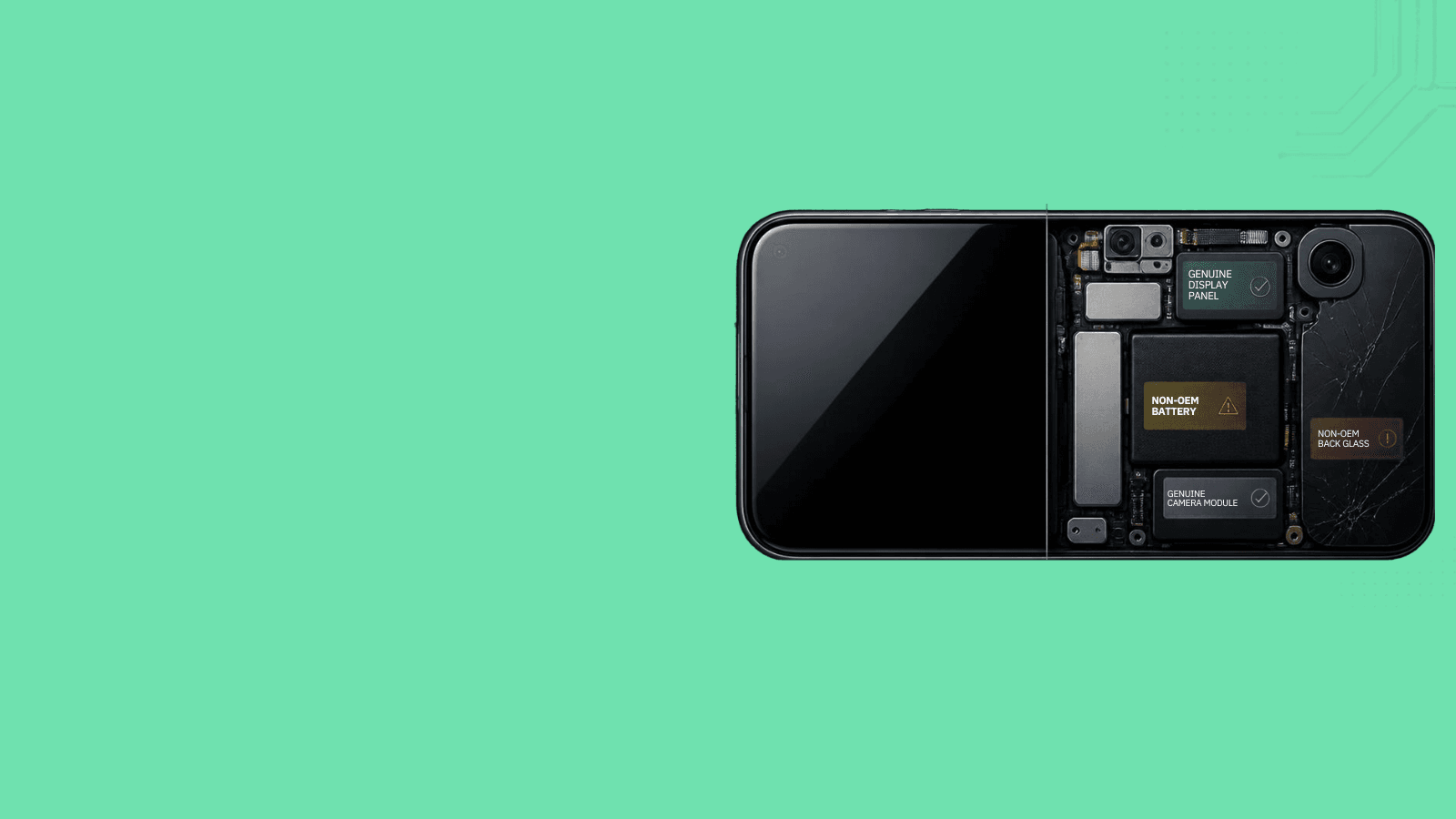
Lower-grade handsets are bought in bulk at overseas auctions, imported, and sent through a workshop where the screen, battery, rear camera or back glass — often several of these at once — are swapped for non-OEM parts. The device is cleaned, the cosmetics are brought up to standard, and it goes to market as Grade A Refurbished.
Note what that grade is describing: it specifically refers to cosmetic conditions, not to the origin of the parts inside. A phone can be graded A because it looks flawless, and it does so precisely because everything visible on it has been replaced with a copy part. The grade and the replacement are not in tension. They are the same event.
This is not an argument against non-OEM parts
I want to be clear on this, because the distinction matters and it is usually lost. I am not against non-OEM parts. I think they have a genuinely important role in the second-hand market. They keep repair affordable, they extend the working life of devices that would otherwise be discarded, and for a four-year-old handset they are often the only economically sensible option. A market where the only choice is a genuine part at manufacturer pricing is a market where a large number of perfectly repairable phones simply get thrown away.
What I am against is the ambiguity and the lack of transparency. A non-OEM part sold as a non-OEM part is a legitimate product. A non-OEM part sold under a word the customer understands to mean the opposite is something else.And the gap that this ambiguity conceals is not small.
The screen problem
Let me take the iPhone Pro Max screen as an example to illustrate my point. A genuine Pro Max display costs in the UAE exactly AED 1,499. It costs the same for the for recent various models of ProMax, easing to AED 1,299 once you go back a few generations. Non-OEM alternatives for the same models start somewhere around AED 50 and run up to roughly AED 300 depending on the tier.
That range of AED 50 to 300 is in itself worth pausing on, because it is not one product. At the bottom of this scale you can find LCD panels — not OLED at all, with the wrong black levels, no always-on display, and if fitted on Pro Max models it will lock to a lower refresh rate than what the phone was originally sold with.
In the middle sit rigid "hard OLED" panels, with their thick bezels and brittle enough to easily shatter. At the top sit flexible soft OLED panels that come genuinely close to the original. A customer told only that a screen was "replaced" has been told nothing that distinguishes these; if he was told anything other than “Refurbished” in the first place.
The economics follow directly. A refurbished handset carrying a AED 50 panel, masquerading as a Grade A refurbished device, can be sold for not much more than the price of the official screen alone. The margin in that transaction is not created by skilled work, or careful running of a refurbishment center, it is created by the customer not knowing what exactly is he buying.
The battery problem
Batteries deserve their own mention, because the variance there is less visible and more consequential. A copy cell and a genuine cell look identical and behave identically for the first few months. The differences emerge later: real capacity well below the printed figure, life cycle that can be less than half the original, and cloned gauge chips programmed to report perfect health indefinitely — which conveniently suppresses the warning notice, and simultaneously removes the only diagnostic the owner had.
Unlike a screen, a degraded battery is a major safety concern, and should not be taking lightly. Again a refurbished device is banking on the customer ignorance.
Two ways out
Route one: manufacturers regulate their aftermarket
The manufacturers can regulate their own aftermarket through pricing.
The current price of a genuine part is, in effect, a decision to cede the repair market to copy parts. It does not have to be. A manufacturer could designate a limited number of service centers that meet defined standards — technician certification, traceability, warranty obligations — and give those centers privileged access to genuine parts at a materially lower price, starting from a chosen model generation onward.
This is not charity. It converts an aftermarket the manufacturer currently has no visibility into, and no revenue from, into a channel it partly controls. Every repair done with a genuine part inside that network is a repair not done with a copy part outside it, and it protects the brand from being judged on a device carrying none of its components.
Route two: transparent third-party refurbishment
The second route needs no manufacturer cooperation at all. It needs one reputable party to run a service operation that does proper triage and repair using non-OEM parts, states so openly, grades the parts it uses, and prices accordingly — with a warranty attached to that disclosure rather than despite it.
My argument is that this is a commercial opportunity, not a handicap. The current market forces every buyer to assume the worst, which means the operator using a good soft OLED panel and a branded cell earns exactly the same trust as the one using the cheapest available of each. Disclosure is the only thing that lets quality command a price. Right now nothing does.
The minimum
However this market eventually sorts itself out, one thing should not be optional. Any device sold as refurbished or renewed should state which parts were replaced and what grade of part was used.
Not in the small print, and not on request — on the listing, as visible as the price of the device.
That is a low bar. It is lower than what we require of almost anything else a consumer buys. And until we clear it, the word refurbished will keep doing the one job it was never supposed to do: standing in for information the customer was never given.