

9-minute read · Updated 5 October 2026
The second-hand device market only works when consumers take part on both sides: trading in the devices they no longer need, and buying used devices with clear information. In the GCC, only single digits of customers, 10% at most, trade in a device when they buy a new one at most retailers, against close to 30% in Europe. Ghassan Bendali, founder of 2USE (Second Use), a Dubai company trading since 2022, sees three things that make people trade in: an easy process, a fair price and guaranteed data wiping.
Key takeaways
Before you trade in: back up your data, sign out of Find My or Find Hub, erase the device and remove the SIM card.
Before you buy: choose a seller that can be held responsible, with a written warranty, a free return period and clear grading.
When it arrives: check beyond the cosmetics for signs of tampering, using the 4 short videos below.
This is the third and last article in a series on what stands in the way of the second-hand device market reaching its full potential. In the first article, I argued for a standardized grading system and how retailers can help build one. In the second, I discussed the damage that poorly defined refurbishment does to this market and what vendors are responsible for. Here I focus on the last pillar after the vendor and the retailer: the consumer.
At a glance
Trade-in rate, GCC retailers | Single digits, 10% at most of device sales |
Trade-in rate, Europe | Close to 30% |
What makes people trade in | An easy process, a fair value, data integrity |
2USE estimate | Rough value in seconds; full evaluation in under 6 minutes |
2USE data wipe | Certified data erasure, free of charge |
2USE pays you by | Trade in (instant discount), buyback (store credit) or sell (cash within 48 hours of inspection) |
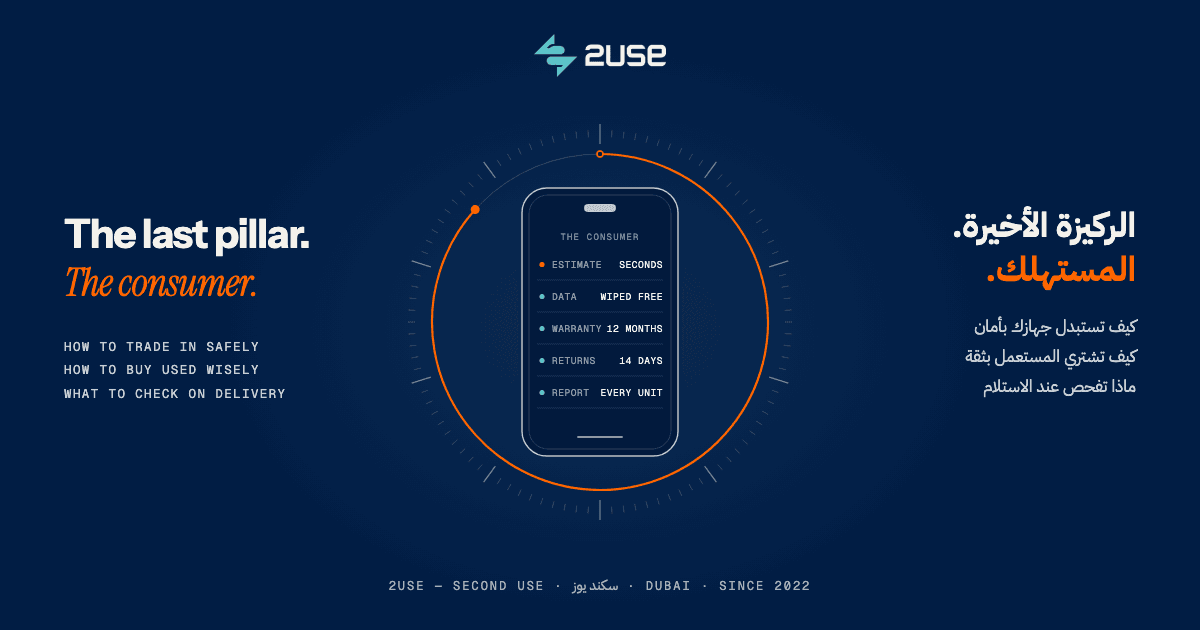
2USE buyer protection | 12-month warranty, 14-day free returns, a diagnostic report for every device |
The circular economy starts and ends with the consumer
A circular economy only works if the consumer takes part on both sides. Someone who no longer needs a device has to believe it can be useful to someone else. Someone who needs a device has to accept that they don't need the latest bells and whistles, and that a decent second-hand device can serve them well.
The second-hand device market is thriving in the Middle East, including the GCC. Few people here trade in their old devices, though. At most retailers in the region, the trade-in attach rate (the share of device sales that include a trade-in) is in single digits, 10% at most. In Europe the norm is close to 30%. The demand is therefore met mostly by imports, and I have already written about the pitfalls of that supply chain. Local trade-ins are the healthier source: the devices are easier to trace, their history is easier to verify, and more of the value stays in the local market.
Getting consumers to trade in
If we want people to trade in their older devices instead of leaving them in a drawer, three things need to come together.
An easy procedure. Consumers need a quick way to have their device evaluated and to receive an offer. A lot of progress has been made here. On the 2USE buyback page, a rough value appears in seconds, and the full evaluation takes less than six minutes. The customer then chooses how to be paid: an instant discount on a new device (trade in), store credit (buyback) or cash (sell). If trading in feels harder than keeping the phone in a drawer, the drawer wins.
A fair value. Many consumers, especially those who bought premium devices, would rather keep the phone at home than sell it for a low price. The company buying the device has costs to cover and needs some profit to stay in business. There is a sweet spot where the consumer feels comfortable and the buyer still makes money. The more organized this market becomes, with clear grading, reliable diagnostics and predictable resale prices, the higher the prices buyers can afford to offer.
Data integrity. This is the main non-negotiable issue. Is my data at risk? Whether the data is personal or commercial, this worry puts many people off a trade-in. At 2USE, certified data erasure is free of charge. Consumers should raise this concern with their favorite retailer; once retailers see that customers expect it, most will offer something similar.
"If trading in feels harder than keeping the phone in a drawer, the drawer wins."
Ghassan Bendali, Founder & CEO, 2USE
How to prepare your device for a trade-in
Check the approximate price. Many retailers' websites give an instant estimate. It tells you what your device is realistically worth before you commit.
Back up your data. Do it at home, before anything else, and confirm that the backup works.
Sign out of every security and account lock. That means Find My (iPhone), Find Hub (Android) or Samsung Find, and any cloud accounts. A device still linked to your account can lose much of its value or be refused.
Erase and reset the device as soon as possible, and remove your SIM card, so that nothing of yours remains on it.
Gather the extras. The original box, charger and accessories, if you still have them, can improve your offer.
For the buyer: how to protect yourself
Handing over hard-earned cash to a stranger and taking their word for it is always risky. Is this shirt genuine? Was this car in an accident? Was this phone tampered with? The first order of business is to buy from a company that can be held responsible for what it sells. Here is a checklist:
Who is actually selling? Find out whether the company sells its own devices or runs a marketplace. There is nothing wrong with a marketplace, but quality there depends on each individual seller.
Read the user reviews. Did other customers have problems? If so, were they solved, and how quickly?
Look for a warranty. Resellers who offer a warranty and state it clearly in their terms are far more reliable than those who say nothing about it.
Check the return policy. A free return period lets you confirm that the device really is as advertised. If it isn't, you send it back at no loss.
Ask about grading. Does the reseller use a clear grading system? What should you expect from a top-grade device compared with a lower grade? At 2USE, the four grades are Like New, Excellent, Very Good and Good.
Understand what "refurbished" means. If a device is sold as refurbished or renewed, ask who refurbished it and with which spare parts. Without clear answers, the word tells you very little. (Used vs refurbished: what's the difference?)
Resellers who give these assurances carry larger costs, so they may charge slightly more than a seller whose only presence is a couple of marketplace listings. That difference usually pays for the warranty, the returns and the testing behind the device.
At 2USE, we apply all of these measures and more, so that customers have as much information as possible before they decide and as many options as possible afterwards: a 12-month warranty, a 14-day free return window, and full information on every device, including its diagnostic report. Browse used phones.
Consider a lower grade, with a plan
A top-grade device is not the only sensible choice. Some buyers are better served by a lower-grade device with minor cosmetic wear or a battery past its best, as long as the internals are healthy. It usually costs less. If you later replace the battery or screen at an authorized service center, you decide which spare parts go into your device, instead of relying on someone else's choice.
Before going this route, check two things. First, confirm with the seller that an outside repair won't void the warranty. At 2USE, a repair at an authorized service center does not void our 12-month warranty. Second, get a repair quote and compare the total with the price of the higher grade. If the numbers work, this can be the best way to get quality you can verify at a fair price.
When the device arrives
The first thing to do when a device arrives is to check that it is what you expected, and look beyond the cosmetics. Look for signs of tampering: marks around the screws, mismatched parts or unusual behavior. I have recorded short video guides on how to check your device:
Video | What you will learn | Length |
1 | What to check on a used phone | 1:30 |
2 | How to check a used iPhone's physical condition | 1:17 |
3 | How to tell if an iPhone screen is genuine or replaced | 0:46 |
4 | Apple-authorized software and diagnostics | 1:25 |
All 4 videos | About 5 minutes in total | 5:18 |
Video 1: What to check on a used phone
Ghassan Bendali's short overview of what to look at before you trust a used phone.
Video 2: How to check a used iPhone's physical condition
What to inspect on the body, frame and screen of a used iPhone before you accept it.
Video 3: How to tell if an iPhone screen is genuine or replaced
The signs that show whether an iPhone still has its original screen.
Video 4: Apple-authorized software and diagnostics
How Apple-authorized software and diagnostic tools are used to check a used iPhone, beyond what you can see from the outside.
For the full written checklist, read how to spot a genuine used phone.
Share your experience
Finally, and this matters: share your experience with other consumers, positive or negative. A review of your reseller takes a few minutes and goes a long way toward improving this market. Honest reviews reward the sellers who do things properly and warn others about the ones who don't.
Closing the series
Over three articles, I have looked at the three pillars of the second-hand market. Retailers need to adopt standardized grading. Vendors need to be accountable and transparent about refurbishment. Consumers need to be willing both to trade in and to buy second-hand, and to demand clear information when they do. When all three do their part, the circular economy stops being a slogan and becomes a market that works for everyone.
Read the full series
Mind the Gap: why non-standardized grading is holding back the market
The Refurbishment Trap: how one word is quietly damaging an industry
The Consumer: the last pillar of the second-hand market (this article)
Get an instant estimate for your device →
FAQ
How do I prepare my phone before trading it in?
Back up your data, sign out of Find My (iPhone), Find Hub (Android) or Samsung Find and every cloud account, then erase and reset the phone and remove the SIM card. Check an instant online estimate first, and keep the original box and charger: they can improve your offer.
Is my data safe when I trade in or sell my phone?
It is when the buyer wipes it properly and you erase the phone yourself first. 2USE (Second Use) performs certified data erasure free of charge on every device it buys, so nothing of yours stays on the phone after the trade-in.
Why do so few people in the UAE trade in their old phones?
At most GCC retailers, single digits of customers, 10% at most, trade in a device when they buy a new one; in Europe it is close to 30%. The main barriers are worry about personal data, offers that feel too low, and processes that seem harder than leaving the phone in a drawer.
How do I buy a used phone safely in the UAE?
Buy from a company that can be held responsible: check whether it sells its own stock or runs a marketplace, read its reviews, and look for a written warranty, a free return period and a clear grading system. 2USE gives a 12-month warranty, 14-day free returns and a diagnostic report for every device.
Does repairing a used phone at an authorized service center void the warranty?
It depends on the seller, so ask before you buy. At 2USE (Second Use), a repair at an authorized service center does not void the 12-month warranty, so you can buy a lower grade and replace the battery or screen with parts you choose.
About the author
Ghassan Bendali is the founder and CEO of 2USE (Second Use), a Dubai company selling original used phones, laptops and tablets since 2022. Ghassan Bendali on LinkedIn